A Stablecoin Payment Is Not a Transfer. It’s a State Machine.
Learn why production stablecoin payments need explicit order states, deterministic transfer matching, finality tracking, idempotency, and reliable webhooks.
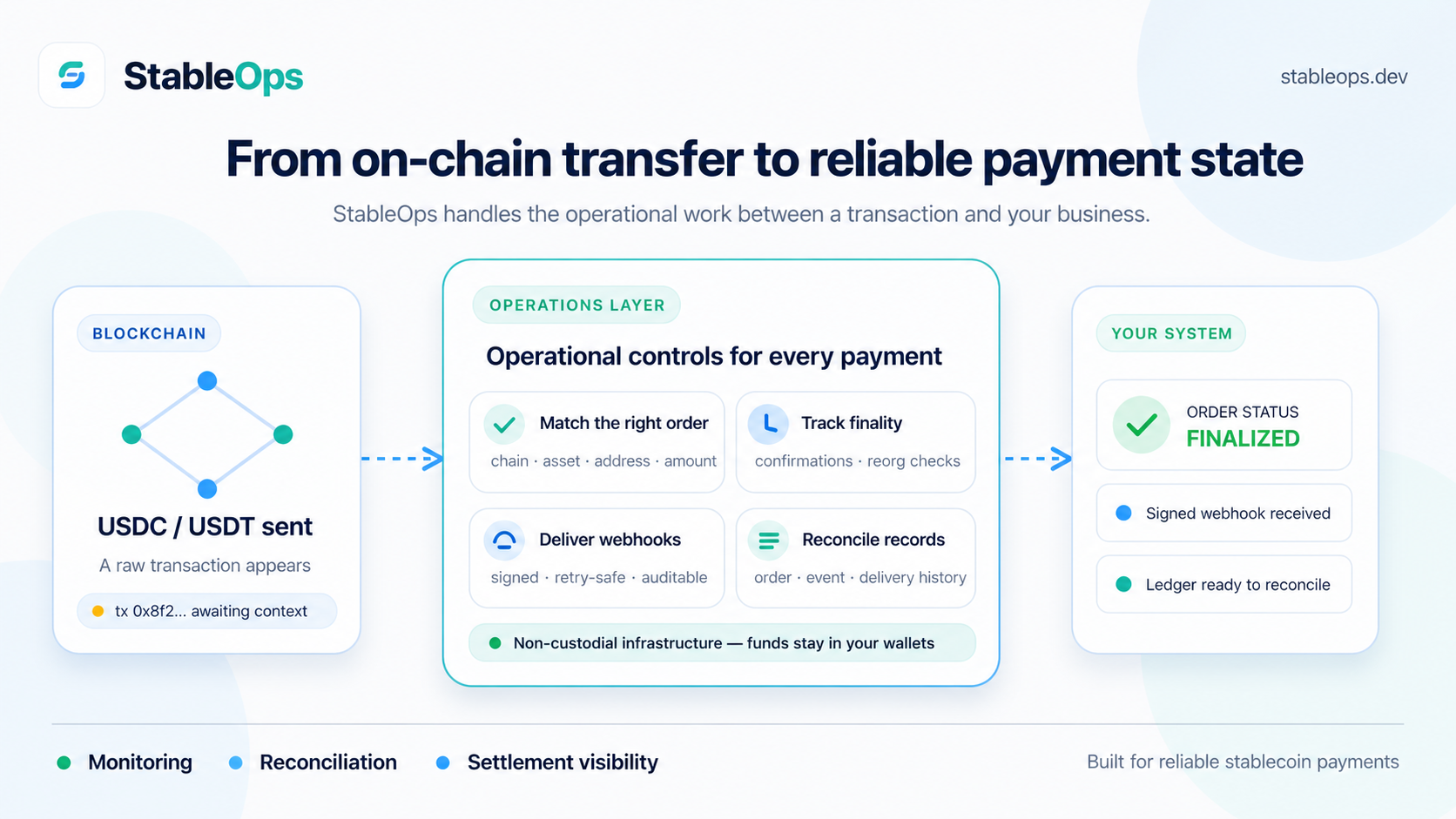
The first version of a stablecoin checkout looks deceptively simple:
- Show the customer a wallet address and an amount.
- Wait for a USDC or USDT transfer.
- Mark the order as paid.
That is enough for a demo. It is not enough for a payment system.
The moment real orders and real money enter the picture, the useful question is no longer, “Did this address receive tokens?” It becomes:
Did the right order receive the right asset, on the right chain, at the right address, for the right amount, within the allowed time—and is the result final enough to fulfill safely?
That is not a balance-checking problem. It is a state machine.
This distinction is the reason stablecoin payments often feel easy during a prototype and unexpectedly difficult in production. The blockchain settles value, but it does not maintain your application’s payment state.
A transfer and a payment are different objects
An on-chain transfer tells you that tokens moved from one address to another. A payment carries business context that the chain does not know:
- which cart, invoice, or subscription the transfer belongs to;
- which chains and token contracts the merchant agreed to accept;
- the exact expected amount and expiration time;
- whether an observed transaction has enough confirmations;
- whether fulfillment already happened; and
- what to do if a delivery is retried or a block is reorganized.
A transaction hash is evidence. It is not an order ID, a fulfillment lock, or an accounting record.
This is why a production architecture needs an explicit payment order between the application and the chain:
Business order
      |
      v
Payment order
(chain + asset + address + amount + expiry)
      |
      v
On-chain transfer
      |
      v
Detected -> Confirmed -> Finalized
      |
      v
Verified event -> Idempotent fulfillment
The payment order binds business intent to settlement evidence. Without it, the application is left trying to infer intent from wallet activity after the fact.
“Paid” is too small for the real lifecycle
A Boolean paid field collapses several materially different states into one value. A safer model makes those states explicit:
created -> detected -> confirmed -> finalized
   |          |            |
expired    reverted     reverted
Each transition answers a different operational question.
created: what should the customer send?
The payment order exists, and the application can present an exact instruction: chain, token, receiving address, amount, and expiration.
Nothing has been paid yet. The important property here is determinism. If the client retries order creation after a timeout, the same idempotency key should return the same logical result rather than allocate another address or create a second payment attempt.
detected: did a matching transfer appear?
The transfer has been observed in a queryable block and matched to the payment instruction.
This is a useful user-experience signal: “Payment received, confirming.” It is not a safe trigger for irreversible fulfillment. A newly observed block may be replaced, the receipt may fail validation, or the event may not survive later checks.
confirmed: has the transfer reached an application-specific confidence threshold?
The transfer has accumulated the configured number of confirmations for that chain. Some applications may choose to perform reversible, low-risk actions here.
The threshold should reflect the product’s risk, not a universal belief that one number works for every chain and every order value.
finalized: is this the fulfillment point?
The payment has reached the platform’s configured final confirmation depth. This is the normal point for triggering irreversible fulfillment.
“Finalized” should still be understood as a product-level risk decision, not a magical claim that distributed systems have become infallible. High-value flows may require additional controls, reconciliation, or manual review.
reverted: what happens when optimistic state is invalidated?
If the stored receipt disappears, fails, or no longer matches the block hash after a reorganization, the payment must move backward into an explicit failure path.
Rare states are still real states. If the data model cannot represent a reversal, the operational team will eventually be forced to repair it outside the system.
Match the instruction, not the balance
Watching an address balance is attractive because it appears universal. It also removes most of the information required to attribute a transfer safely.
At minimum, matching should be scoped by:
(organization, environment, chain, asset, address, amount)The chain matters because the same address format can appear on multiple EVM networks. The asset matters because a symbol such as “USDC” is not a unique token identity; contract addresses distinguish official assets from unrelated tokens using the same symbol. The environment matters because production and test activity must never meet. The amount and address connect the transfer to one open payment instruction.
Expiration matters too, but it belongs in policy as well as matching. A late transfer does not disappear just because an order expired. It becomes an exception that needs a defined resolution: accept it, refund it, credit it manually, or create a support case.
The same is true for underpayments, overpayments, wrong-chain transfers, and wrong-asset transfers. A reliable system makes these cases visible instead of silently treating “the balance went up” as success.
Idempotency must exist at more than one boundary
Distributed payment systems retry. Browsers retry. Clients time out. Webhooks are redelivered. Operators replay events during incident recovery. Workers crash after completing an external side effect but before recording success.
Trying to suppress all of these with one idempotency key leaves gaps. There are at least three separate protections:
- Request idempotency prevents a retried API call from creating a second payment order.
- Event deduplication prevents the same webhook event from applying the same state transition twice.
- Fulfillment idempotency prevents two valid code paths from shipping, crediting, or granting access twice for the same business order.
These keys describe different identities. A request key identifies one creation attempt. An event ID identifies one fact emitted by the payment system. A merchant order ID identifies the real-world obligation that must be fulfilled exactly once.
Conflating them works until two distinct events refer to the same order—or until one event is replayed through a new delivery attempt.
Webhooks are a delivery protocol, not a function call
Developers often write a webhook handler as if the sender invokes it exactly once and receives a clean response. The network does not provide that guarantee.
Consider a normal failure sequence:
- Your endpoint verifies a
payment.finalizedevent. - It updates the order and commits the database transaction.
- The response is lost before the sender receives it.
- The sender retries the same event.
Without durable event deduplication, the same payment may trigger fulfillment twice. The sender did nothing wrong; retrying was the only safe choice.
A robust webhook boundary looks like this:
Receive request
      |
      v
Read exact raw body
      |
      v
Verify signature
      |
      v
In one transaction:
  insert unique event ID
  update business state
  write fulfillment outbox record
      |
      v
Return 2xx
      |
      v
Worker fulfills idempotently by business order ID
The raw body matters because parsing and re-serializing JSON can change the bytes covered by the signature. The database transaction matters because an event record without its corresponding state change—or a state change without its durable next step—creates an ambiguous recovery point. The outbox matters because slow external fulfillment should not hold a webhook request open.
The correct delivery contract is usually at least once, with idempotent processing on the receiver. “Exactly once” is an outcome assembled from durable state and carefully chosen keys, not a property supplied by HTTP.
Non-custodial does not mean operations-free
Stablecoins make it possible for funds to move directly from a customer-controlled wallet to a merchant-controlled wallet. That is a valuable custody model: a payment operations provider does not need to hold the merchant’s private keys or take possession of the funds.
But removing custody does not remove the work between a raw transaction and a reliable business event.
Someone still has to:
- allocate or select receiving addresses;
- watch several chains and token contracts;
- normalize and match transfer events;
- track confirmations and check for reorganizations;
- expire unused payment instructions;
- sign, retry, audit, and replay webhook deliveries; and
- preserve enough history for reconciliation and support.
This is the operations layer. It sits between settlement and the merchant’s application, translating chain activity into deterministic payment state.
The practical test: can the system recover?
The best test of a payment integration is not whether the happy path works. It is whether the system can explain and recover from an interrupted path.
Before production, test at least these cases:
- the order-creation response times out and the client retries;
- the same webhook arrives twice;
- two different events for the same order arrive concurrently;
- the webhook transaction commits but its response is lost;
- the fulfillment worker crashes mid-operation;
- a detected payment is later reverted;
- a transfer arrives after the payment order expires; and
- the webhook endpoint is down long enough to require replay.
For every case, ask three questions:
- What durable record proves what happened?
- Which operation is safe to retry?
- Which key prevents the business side effect from happening twice?
If those questions have precise answers, the integration is becoming a payment system rather than a transaction listener.
Why we are building StableOps
We are building StableOps around this separation of concerns.
The blockchain moves USDC and USDT directly into merchant-controlled addresses. StableOps maintains the payment order and operations layer: deterministic matching, confirmation tracking, reorganization checks, idempotent APIs, and signed webhook delivery. The merchant’s application remains the authority for its business order and fulfillment.
Our goal is straightforward: make a stablecoin payment feel like a reliable application primitive without turning it into a custodial black box.
If you are implementing this architecture yourself, the StableOps payment order documentation and webhook guide describe the state and delivery models in more detail. You can also run the Sandbox quickstart to exercise a complete payment loop before connecting real funds.
The transfer is the settlement event. The state machine is the payment system.
Related articles
There is no single best chain for stablecoin payments. Compare payer-side fees, finality, and wallet distribution, then accept a set of chains and match each transfer to an order.
Accept USDT payments with chain-specific instructions, exact order matching, confirmation tracking, and verified webhook fulfillment.
Learn how to refund finalized stablecoin payments with verified addresses, exact amounts, signed transactions, idempotent webhooks, and on-chain reconciliation.
Learn how crypto deposit monitoring uses unique addresses, finality, idempotent webhooks, and reconciliation to credit customer deposits safely.