A Budget Is Not a Payment Policy for AI Agents
Learn why AI agent payment safety needs scoped policies, exact approvals, constrained signing, idempotent retries, and budgets—not spending caps alone.
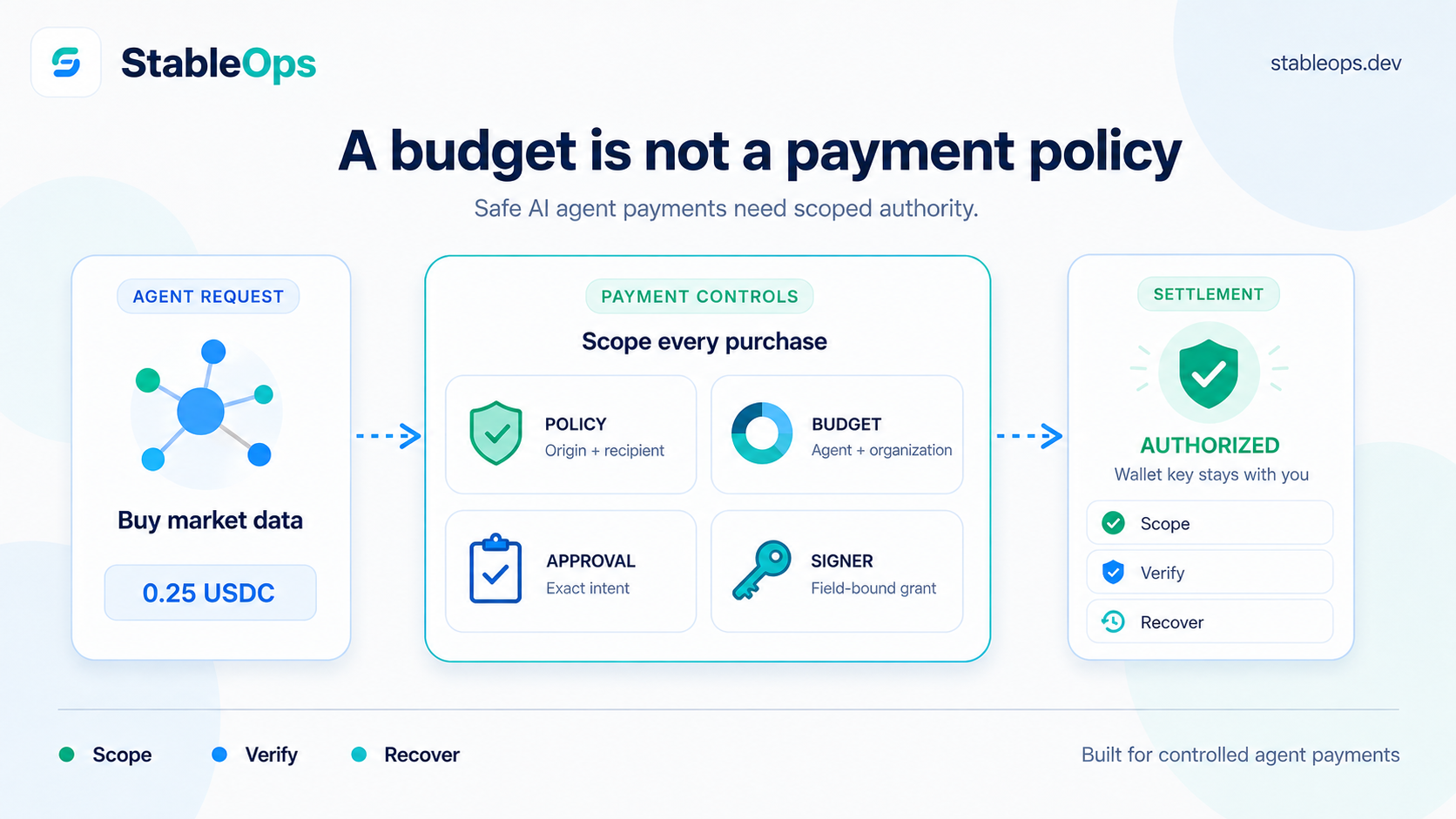
Giving an AI agent a spending limit feels like responsible automation.
It is also dangerously incomplete.
A daily budget can answer one question: how much value may leave during a period? It cannot answer who may receive it, which service may request it, what asset may be used, whether the quote changed after approval, or whether a timeout means the payment failed.
An agent that stays under budget can still pay the wrong recipient one hundred times.
If an autonomous system can spend money, it needs more than a wallet and a number. It needs a payment policy that binds business intent to the exact transaction the signer will authorize.
A limit controls quantity, not purpose
Suppose a research agent may spend 10 USDC per day. That rule sounds conservative. Now consider what it permits if implemented as the only control:
- 10 USDC to a service the operator has never approved
- 0.10 USDC repeated one hundred times after a retry loop
- a payment on the wrong network to an address with the same format
- a valid charge whose recipient changed between preview and execution
- a payment for a
POSTrequest whose body is not the body the user reviewed - a second authorization after the first request timed out but the transfer succeeded.
Every outcome can remain below the daily cap.
A budget is therefore an accounting boundary, not a complete authorization boundary. It limits aggregate exposure, but it does not express why a payment is allowed.
That distinction is familiar in other security systems. A database role is not defined only by the number of queries it can run. A cloud identity is not safe merely because its monthly bill has an alert. Financial authority also needs scope.
Treat a purchase as structured authority
The permission to make an agent payment should be represented as a structured intent, not as “the model may use this wallet.” At minimum, that intent should bind:
| Dimension | Authorization question |
|---|---|
| Agent | Which autonomous identity is requesting the purchase? |
| Resource origin | Which service is allowed to issue the payment requirement? |
| HTTP request | Which method, URL, request body, and content type is the agent trying to use? |
| Recipient | Which exact address may receive the funds? |
| Network and asset | On which chain, using which token contract or mint, may payment occur? |
| Amount | What is the maximum amount for this one purchase? |
| Time | How long is this authorization valid? |
| Replay identity | Which stable key makes a retry part of the same purchase attempt? |
This is the difference between giving software money and giving software a narrowly described job that may require money.
The model may decide that it needs a paid weather record, market dataset, or inference result. It should not be the final authority that decides whether any address presenting that resource is allowed to receive funds.
Separate the four trust boundaries
Safe agent payments are easier to reason about when four responsibilities remain separate.
1. The agent runtime requests
The runtime chooses a resource and asks to make a purchase. It holds a restricted, revocable credential scoped to its own payment attempts.
It should not hold the organization’s management key. It should not be able to edit its own limits, approve its own exception, register a replacement wallet, or call a general-purpose signing method.
This matters even when the model is behaving correctly. The runtime processes untrusted tool output, remote content, and prompts. A compromised dependency or prompt injection should not inherit the full authority of the treasury.
2. The control plane decides
The control plane compares the proposed purchase with an active policy and current budgets. It can reject the request, approve it automatically, or pause it for a human decision.
The decision should use normalized data rather than prose: origin, recipient, network, asset, exact amount, Agent identity, and request identity. For non-read-only requests, it should also bind the HTTP method and a digest of the request body.
3. A human approves exceptions
Approval should authorize one locked intent, not permanently relax the policy.
If the recipient, network, asset, method, body, or amount changes after review, the old approval must not apply. The new request should be rejected or returned for another decision.
An approval screen that says only “Allow this agent to spend 2 USDC?” hides the information a reviewer actually needs. It should say what will be purchased, from which origin, for which recipient, on which network, using which asset, and whether the action can be retried safely.
4. The signer verifies
The process that holds the wallet key should not trust the agent runtime just because both run inside the same company.
Instead, it should accept a short-lived execution grant from the control plane and verify that the payment payload matches every authorized field. The grant should bind the Agent, wallet, environment, network, asset, recipient, amount, nonce, and validity window. Replays, expired grants, unknown issuer keys, and field mismatches should fail closed.
The signer’s interface is as important as its key storage. Putting a private key in AWS KMS but exposing a generic sign(anything) endpoint simply moves an unrestricted capability behind a network call. A constrained signer should expose payment-specific operations only.
Policies should be immutable at execution time
A mutable policy creates an uncomfortable audit question: which rules authorized the payment that happened ten minutes ago?
Version the policy document and make each activated version immutable. A new allowlist or limit becomes a new version rather than an in-place edit. Every payment intent records the version used for its decision.
A compact policy might look like this:
const policy = {
  allowedOrigins: ['https://data.example.com'],
  allowedPayTo: ['0x1234567890abcdef1234567890abcdef12345678'],
  automaticPaymentThresholdAtomic: '250000', // 0.25 USDC
  perPaymentLimitAtomic: '1000000', // 1 USDC
}
This document separates three outcomes:
- A request above the per-payment limit is rejected. Human approval should not silently bypass a hard ceiling.
- A request within the hard limit but outside the automatic allowlist or threshold waits for approval.
- A request whose origin, recipient, amount, network, asset, and budgets all pass may proceed automatically.
Daily budgets still matter. Use both an organization-wide budget and an Agent-specific budget so one runtime cannot consume the entire organization allowance. Reserve budget atomically before signing. Otherwise, concurrent requests can each observe the same remaining amount and collectively exceed it.
But the policy is what explains why the spend was permitted. The budget only proves that capacity remained.
Preview and approval must survive a changing quote
HTTP-native payment protocols such as x402 make it possible for a resource server to return a payment requirement and for the client to retry the request with payment credentials. That solves an important protocol problem: how a price, payment payload, verification step, settlement step, and resource response fit into an HTTP exchange.
It does not decide what an individual organization wants its Agent to buy.
Between the initial preview and execution, the resource server may return a refreshed requirement. A safe client compares it with the approved intent. A lower amount may be acceptable if the policy says so. A different recipient, origin, network, asset, request body, or higher maximum amount is a different purchase.
This is where a field-bound approval earns its complexity. The agent cannot use approval for “a report from example.com” to authorize a modified request that uploads different data or pays a different address.
Timeouts create uncertainty, not permission to pay again
The most dangerous retry happens after signing.
Imagine this sequence:
- The policy permits a purchase.
- The signer authorizes the exact payment.
- The paid request is sent.
- The client times out before receiving the resource or settlement response.
The payment may have failed. It may also have succeeded.
Creating a new intent immediately can produce a double charge while staying within every allowlist and per-payment limit. The correct state is not failed. It is settlement_unknown until evidence resolves it.
Recovery needs stable identity:
- reuse one task-scoped idempotency key for the same purchase attempt
- persist the original payment intent ID
- resume an approved intent instead of creating another
- query and reconcile the original payment after a timeout
- never interpret “no response” as “no transfer.”
Autonomous systems tend to retry aggressively because that behavior is useful for ordinary software tasks. Payment tooling has to replace that optimism with explicit uncertainty states.
The audit record should reconstruct the decision
An operator investigating one Agent payment should be able to answer:
- Which Agent and task requested it?
- Which policy version evaluated it?
- Which origin, method, URL, and body digest were bound?
- Which recipient, network, asset, and amount were approved?
- Which organization and Agent budgets were reserved?
- Was it automatic or manually approved, and by whom?
- Which execution grant and signer handled it?
- What did the resource request return?
- What is the on-chain transaction reference and settlement state?
Do not log wallet private keys, complete payment signatures, raw execution grants, or sensitive response bodies to make this record complete. Auditability comes from stable identifiers and hashes, not from copying secrets into logs.
A minimum control model for agent payments
Before allowing automatic payment, require all of the following:
- a dedicated payment Agent with a revocable runtime credential
- a wallet dedicated to a narrow purpose and environment
- an immutable policy version with explicit origins and recipients
- network and asset validation against the exact payment requirement
- a hard per-payment limit plus Agent and organization daily budgets
- an automatic threshold lower than or equal to the hard limit
- human approval for unknown or above-threshold requests
- approval bound to the exact HTTP request and payment fields
- a customer-controlled signer with no arbitrary signing endpoint
- a short-lived, one-time execution grant
- stable idempotency and intent IDs across retries
- an explicit settlement-unknown and reconciliation path.
Start with an automatic threshold of zero. Make the first payment with human approval. Add one known origin and recipient only after verifying the complete record. Increase autonomy by narrowing known-safe paths, not by giving the model a more powerful credential.
When you are ready to turn these controls into a launch gate, use the 12-point AI agent payment security checklist to score verifiable evidence and run failure drills.
Why we are building this layer
StableOps Agent Payments is designed around these boundaries. The Agent runtime gets a restricted Agent Key. Immutable policies and two levels of budget govern each intent. Unknown or above-threshold purchases wait for approval. A short-lived execution grant authorizes a customer-hosted signer, while the wallet key or KMS permission stays in the customer environment.
The goal is not to make every payment automatic. It is to make the boundary between automatic, reviewable, and forbidden payments explicit—and to preserve that boundary when networks time out, quotes change, and processes restart.
An Agent budget tells you how much it may spend.
A payment policy tells you whether this purchase should exist at all.
Related articles
Use this 12-point production checklist to evaluate AI agent wallet security across credentials, policy, approvals, constrained signing, retries, and audits.
Compare MCP and x402, learn how agents discover and call paid tools, and add policy, budgets, approvals, and constrained signing for production use.
Build AI agent payments with buyer-side policies, budgets, approvals, and customer-controlled signing, plus seller-side payment orders, finality, webhooks, and reconciliation.
Use x402 for HTTP-native agent payments, but keep merchant-side order state, policy, finality, webhooks, and audit trails separate.